
French Street Signs: What the Words Mean in English
French street signs in English: rue, impasse and place on name plaques, plus priorité à droite, parking, péage and words to know before driving in France.
Published October 16, 2026 · By Frame Sixty Labs
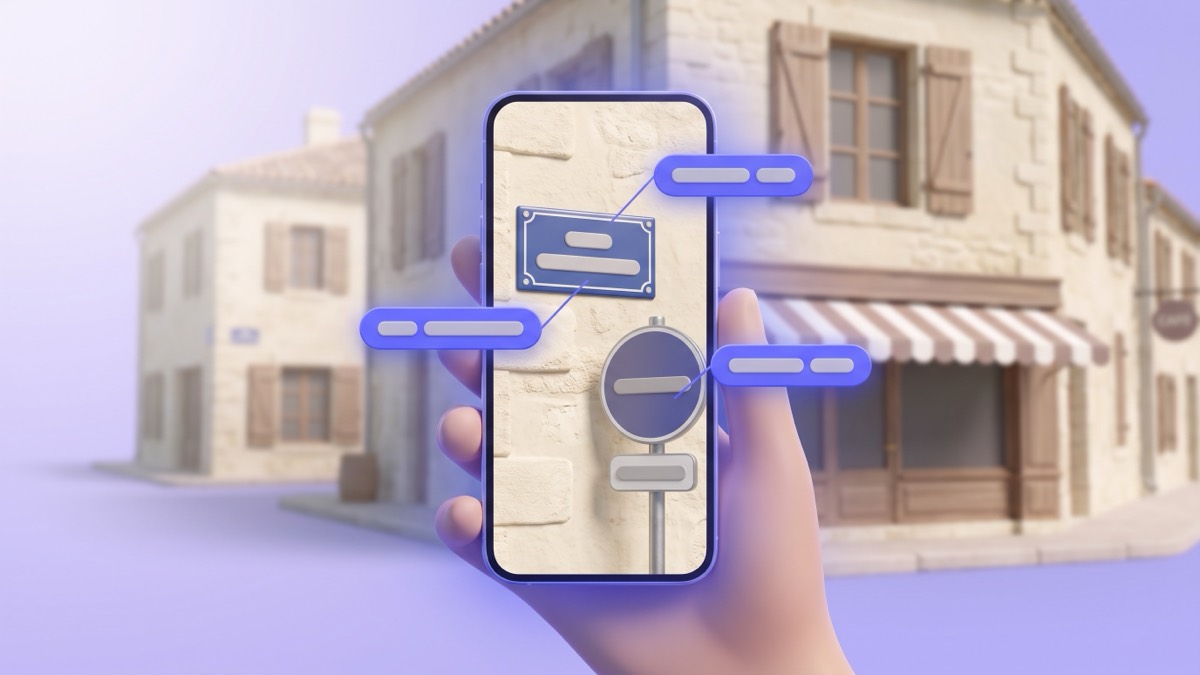
Quick answer: French street signs come in two kinds. Name plaques on walls use words like Rue (street), Avenue, Boulevard, Place (square), Quai (riverside road) and Impasse (dead end). Road signs add words like Sortie (exit), Toutes directions (all directions), Sens interdit (no entry), Stationnement interdit (no parking) and Péage (toll), and a camera translator can read the rest when you are parked.
France uses the same sign shapes as the rest of Europe. A red triangle warns, a red circle bans or limits, and a blue circle gives an instruction. What changes is the French text on plaques, plates and panels. This guide covers street names, the most common road sign words, the priority rule that surprises visitors, and how to translate a sign you do not recognize.
What do French street names mean?
Street names in France sit on plaques fixed to the corner buildings. In Paris they are blue enamel with a green border, and the number at the top is the arrondissement, the city district. The first word tells you what kind of street it is.
| French | Sounds like | English |
|---|---|---|
| Rue | roo | Street |
| Avenue | ah-veh-NOO | Avenue, usually wide and tree-lined |
| Boulevard | bool-VAR | Boulevard, a broad main road |
| Place | plahss | Square |
| Quai | kay | Riverside or harbour road |
| Impasse | an-PAHSS | Dead end |
| Allée | ah-LAY | Lane or path, often tree-lined |
| Chemin | sheh-MAN | Lane or track |
| Passage | pah-SAHZH | Covered or pedestrian passage |
| Rue piétonne | roo pyay-TON | Pedestrian street |
Hints are approximate. In Paris, house numbers start at the end nearest the Seine. Even numbers are on the right and odd numbers on the left as you walk away from the river. That helps when a taxi drops you at the wrong end of a long rue.
What do the most common French road signs say?
These are the words visitors meet on the first day of driving.
| French | Sounds like | English |
|---|---|---|
| Sortie | sor-TEE | Exit |
| Toutes directions | toot dee-rek-SYON | All directions |
| Autres directions | OH-truh dee-rek-SYON | Other directions |
| Centre-ville | SAHN-truh VEEL | Town centre |
| Sens interdit | sahns an-tair-DEE | No entry |
| Sens unique | sahns oo-NEEK | One-way street |
| Cédez le passage | say-day luh pah-SAHZH | Give way |
| Voie sans issue | vwah sahn zee-SOO | No through road |
| Travaux | trah-VOH | Roadworks |
| Déviation | day-vyah-SYON | Detour |
| Route barrée | root bah-RAY | Road closed |
| Ralentir | rah-lahn-TEER | Slow down |
| Rappel | rah-PELL | Reminder, the limit still applies |
“Rappel” appears under a speed limit sign. It does not set a new limit. It reminds you that the one you passed earlier is still in force.
What is priorité à droite?
This rule surprises more visitors than any sign. In France, traffic coming from your right has priority at a junction unless a sign says otherwise. It applies most often in towns and on small country roads.
A yellow diamond with a white border means you are on a priority road and side roads must give way to you. The same diamond with a black line through it means the priority road has ended. From there, cars entering from the right may pull out in front of you, and they are allowed to.
A red triangle with a black cross inside also warns that priority to the right applies at the next junction. When you see a plate reading “Vous n’avez pas la priorité”, you do not have priority at the roundabout or junction ahead. Most roundabouts carry that plate, so traffic already on the roundabout goes first.
How do you read a French parking sign?
Parking signs combine a symbol with a plate of conditions. Read both before you leave the car.
- Check the main sign. A white P on blue means parking is allowed. A blue circle with a red border and one red slash means “stationnement interdit”, no parking. Two crossed slashes mean “arrêt et stationnement interdits”, no stopping or parking.
- Look for “payant”. “Stationnement payant” means paid parking. Pay at the “horodateur”, the ticket machine, or through the local parking app shown on it.
- Look for “zone bleue”. It means free parking for a limited time with a parking disc, the “disque”, set to your arrival time.
- Read the exceptions. “Sauf riverains” means except residents. “Sauf livraisons” means except deliveries.
- Watch for “fourrière”. It means the impound lot, so a sign with that word warns that cars are towed.
What should drivers know about French motorways?
A few rules make the autoroute easier.
- Sign colours. Blue direction signs lead to the autoroute. Green signs lead to main roads. White signs are local routes.
- Speed limits. The standard limit is 130 km/h on the autoroute and 110 km/h in rain. Many two-lane country roads are 80 km/h, though some departments have raised parts of their network to 90. Towns are 50 km/h unless posted.
- Tolls. “Péage” means toll. Take a ticket at the entry and pay at the exit. Avoid lanes marked only with an orange “t”, which are for drivers with an electronic toll badge. Lanes with a card symbol take bank cards.
- Low emission zones. “ZFE” signs mark a zone à faibles émissions. Many cities require a Crit’Air sticker showing the vehicle’s emission class, so check before you drive into a large city centre.
- Headlights. “Allumez vos feux” means switch on your headlights, usually before a tunnel.
How can I translate a French street sign with my phone?
Never do this while driving. Holding a phone at the wheel is fined in France. Let a passenger do it, or wait until you are parked or walking.
- Download the French language pack before the trip. It is about 30 MB.
- Open AI Translate and set the pair to French and English.
- Tap the Text tab and point the camera at the sign or plaque.
- The English appears over the French words, block by block.
- Tap Freeze to hold the frame, which helps from a moving car or when your hand is unsteady.
If you took a picture earlier, use the gallery button on the camera screen. The app reads the French and shows the English in a sheet you can copy. This suits a long parking plate or a notice about street cleaning. French uses the Latin alphabet, accents included, so both the live camera and photo import read it.
Any camera translator with a French pack works in a similar way. AI Translate keeps the pack on the phone, so it still reads signs with no signal in the countryside or a tunnel. The offline translator page explains what works without a connection.
Why does a sign translation sometimes look odd?
Signs use short, formal French, and a few patterns confuse any translator.
- Proper names. “Rue de la Paix” may come back as “Peace Street”. Keep the French name for maps and taxis.
- Abbreviations. “N” is a national road, “D” is a departmental road and “A” is an autoroute. Short forms are often left as they are.
- Symbols in place of words. A crossed-out yellow diamond has no text to read, so the app cannot translate it. Use the priority section above.
Treat the translation as a guide to the words, not legal advice. If a sign still seems unclear, park and walk.
Do the same signs work in neighbouring countries?
Mostly, yes. Shapes and colours match across Europe, while the words change. French-speaking Belgium and Switzerland use many of the same words. Crossing into Italy, the guide to Italian road signs covers ZTL zones and parking lines. Heading east into Germany, the guide to German road signs covers the words there.
Once you have parked, the next French text you meet is usually a chalkboard outside a bistro. The guide to the menu in French covers that. For more French phrases, place names and translation tips for a road trip, the French translator page is the best next stop.
Frequently asked questions
What does Toutes directions mean on a French sign?
Toutes directions means all directions. Follow it when your destination is not listed, because it leads to the main through routes. Autres directions means other directions and does the same job from a junction.
What is priorité à droite in France?
Priorité à droite means traffic coming from your right has the right of way unless a sign says otherwise. A yellow diamond sign means you are on a priority road. When that diamond is crossed out, priority to the right applies again.
What does Impasse mean on a French street sign?
Impasse means a dead-end street, a cul-de-sac. The road sign Voie sans issue means the same thing. Both tell you there is no way through for cars.
Try it before your next trip.
AI Translate is free to start. Download a language once to translate typed text and everyday objects offline, and read Latin-script signs and menus with the camera.