
Signs in Spanish: Common Signs and What They Mean in English
Signs in Spanish explained: the words on exit, push, pull, restroom, warning and road signs, their English meaning, and how to translate one with your phone.
Published October 12, 2026 · By Frame Sixty Labs
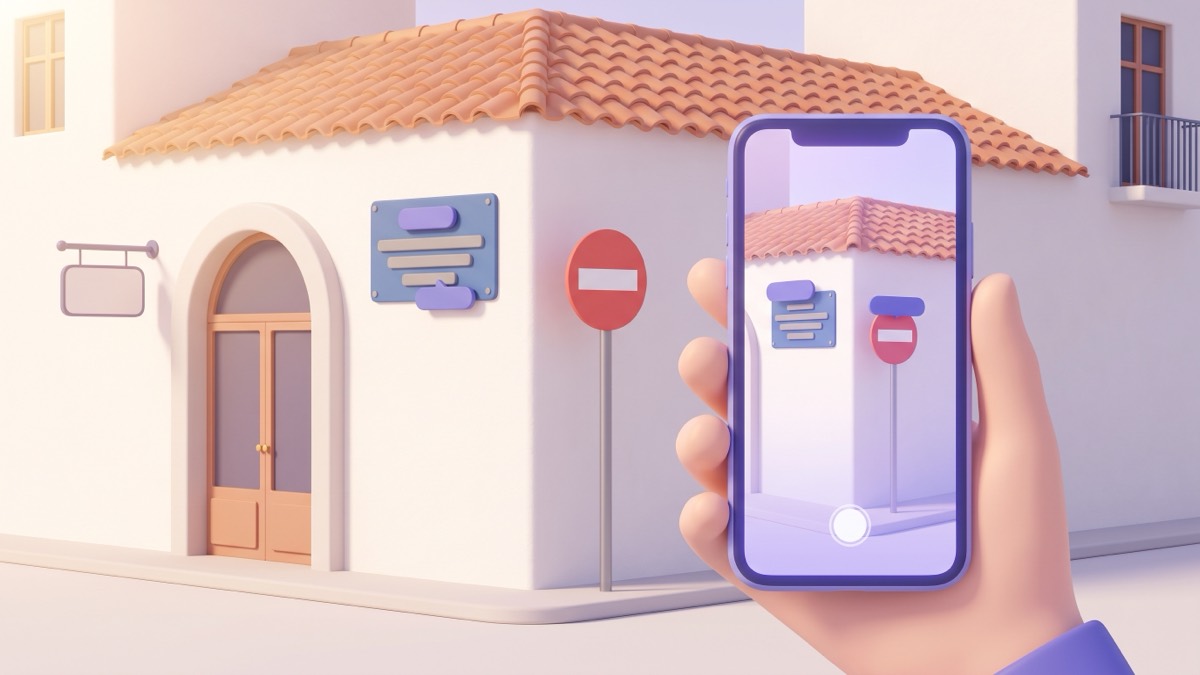
Quick answer: The signs in Spanish you meet most are Salida (exit), Entrada (entrance), Empuje (push), Tire or Jale (pull), Abierto (open), Cerrado (closed), Baños or Aseos (restrooms), Prohibido (forbidden) and Peligro (danger). On the road, Alto or Pare means stop, Ceda el paso means yield and Desvío means detour. Spanish uses the Latin alphabet, so a camera translator can read any sign you do not recognize.
Spanish signs are short, usually one to three words, and a few dozen of them cover almost everything on a door, a wall or a roadside. The catch is that the words change between Spain, Mexico and South America, and some of them look like English words that mean something else. This guide lists the common signs, the regional versions and the mistakes to avoid, then shows how to translate a sign with your phone.
What do the most common signs in Spanish mean in English?
These are the signs on doors, shops, stations and public buildings. Pronunciation hints are approximate.
| Spanish | Sounds like | English |
|---|---|---|
| Salida | sah-LEE-dah | Exit |
| Entrada | en-TRAH-dah | Entrance |
| Salida de emergencia | sah-LEE-dah deh eh-mehr-HEN-syah | Emergency exit |
| Empuje | em-POO-heh | Push |
| Tire | TEE-reh | Pull (Spain) |
| Jale | HAH-leh | Pull (Mexico) |
| Abierto | ah-BYEHR-toh | Open |
| Cerrado | seh-RRAH-doh | Closed |
| Baños | BAH-nyohs | Restrooms |
| Aseos | ah-SEH-ohs | Restrooms (Spain) |
| Caballeros | kah-bah-YEH-rohs | Gentlemen |
| Damas | DAH-mahs | Ladies |
| Caja | KAH-hah | Checkout, cashier |
| Privado | pree-BAH-doh | Private |
| Prohibido el paso | proh-ee-BEE-doh el PAH-soh | No entry |
| Prohibido fumar | proh-ee-BEE-doh foo-MAR | No smoking |
| Peligro | peh-LEE-groh | Danger |
| Cuidado | kwee-DAH-doh | Caution, watch out |
| Se vende | seh BEN-deh | For sale |
Two of these trip people up. “Salida” sits above every exit, including the exits of a highway, so it is not the name of a town. “Tire” has nothing to do with wheels. It is the polite command form of tirar, to pull, which is why a door marked Tire opens toward you.
On restroom doors, Caballeros and Damas are the formal pair, and Hombres and Mujeres, men and women, appear just as often. Some places use only a letter, with C or H for men and D or M for women.
What do traffic signs in Spanish say?
Most road signs in Spanish-speaking countries use the same shapes and symbols as the rest of the world. A red triangle warns, a red circle bans or limits, and a blue circle gives an instruction. The Spanish you need to read is on the stop sign, the detour boards and the plates under the symbols.
| Spanish | Sounds like | English |
|---|---|---|
| Alto | AHL-toh | Stop (Mexico, Central America) |
| Pare | PAH-reh | Stop (South America, Caribbean) |
| Ceda el paso | SEH-dah el PAH-soh | Yield, give way |
| Desvío | des-VEE-oh | Detour |
| Obras | OH-brahs | Roadworks (Spain) |
| Hombres trabajando | OHM-bres trah-bah-HAN-doh | Men working (Latin America) |
| Sentido único | sen-TEE-doh OO-nee-koh | One way (Spain) |
| Una vía | OO-nah BEE-ah | One way (Latin America) |
| Velocidad máxima | beh-loh-see-DAHD MAHK-see-mah | Speed limit |
| Zona escolar | SOH-nah es-koh-LAR | School zone |
| Paso de peatones | PAH-soh deh peh-ah-TOH-nes | Pedestrian crossing |
| Tope | TOH-peh | Speed bump (Mexico) |
| Peaje | peh-AH-heh | Toll |
| Sin salida | seen sah-LEE-dah | Dead end |
| No estacionar | noh es-tah-syoh-NAR | No parking |
| Vado permanente | BAH-doh per-mah-NEN-teh | Keep clear, driveway in use (Spain) |
Speed limits and distances are in kilometers everywhere Spanish is spoken, so “Velocidad máxima 60” means 60 km/h, about 37 mph.
“Tope” deserves its own warning. Mexican speed bumps are tall, often unpainted, and the sign is sometimes the only notice you get. “Vado permanente” appears on Spanish garage doors and gates. It means a vehicle may need to drive in or out at any time, so parking in front of it can get your car towed.
Which signs change between Spain and Latin America?
Spanish is one language, but public signs use regional vocabulary. If you learned one set of words and the sign says something else, this table is usually the reason.
| Meaning | Spain | Mexico | Elsewhere |
|---|---|---|---|
| Stop | STOP | ALTO | PARE |
| Pull | Tire, Tirar | Jale | Hale (Colombia, Venezuela) |
| Restrooms | Aseos, Servicios | Baños, Sanitarios | Baños |
| Parking | Aparcamiento | Estacionamiento | Estacionamiento, Parqueo |
| Speed bump | Badén, Resalto | Tope | Lomo de burro, Reductor |
| Roadworks | Obras | Hombres trabajando | Trabajos en la vía |
| For rent | Se alquila | Se renta | Se arrienda |
None of these differences will stop you understanding a sign once you know they exist. A translator app handles all of them, because the English output is the same either way.
How do I translate a sign in Spanish with my phone?
Spanish uses the Latin alphabet, so both the live camera and photo import in AI Translate read it. Do this as a pedestrian or a passenger, never while driving.
- Download the Spanish language pack before you travel. It is about 30 MB and works without a connection afterward.
- Open the app and set the pair to Spanish and English.
- Tap the Text tab and point the camera at the sign.
- The English appears over the Spanish words, block by block.
- Tap Freeze to hold the frame if the sign is high up or you are walking past it.
If you took a picture earlier, tap the gallery button on the camera screen. The app reads the Spanish in the photo and shows the English in a sheet you can copy. This suits a long notice on a gate or a sign you photographed from a bus. The guide to how to translate a picture has lighting and angle tips that make a photo read better.
Everything above works offline once the pack is on the phone, which matters in a metro station or on a mountain road with no signal. The offline translator page explains which features need no connection.
Why does a sign translation sometimes look odd?
Sign Spanish is compressed, and a few patterns confuse any app or dictionary.
- Capital letters drop accents. Many signs are written in capitals without accent marks, so DESVIO and SALIDA DE EMERGENCIA are normal. The meaning does not change.
- Commands look like nouns. Tire can mean pull or throw, so a door sign may come back as “throw”. Empuje, push, is the same kind of polite command.
- Abbreviations. C/ is calle, street. Avda. is avenida, avenue. Pza. is plaza, square. Hrs. is horas, hours. Short forms are often left untranslated.
- Prohibido sentences. A long sign that starts with Prohibido is a ban. “Prohibido bañarse” means no swimming.
Treat a translation as a guide to the words, not as legal advice. If a parking sign still seems unclear, find another space.
What Spanish signs should I learn before a trip?
If you only memorize ten, make them Salida, Entrada, Empuje, Tire or Jale, Abierto, Cerrado, Baños, Prohibido, Peligro and Alto or Pare. Those cover doors, shops, restrooms and the one road sign that matters most.
Portuguese signs look familiar once you know the Spanish ones. Saída is exit, Empurre is push and Puxe is pull. The camera reads Portuguese too, with the pair set as on the Portuguese translator page. Italian shares many roots as well, with Uscita for exit and Spingere for push, covered on the Italian translator page.
Once you are through the door, the next Spanish text you meet is usually a menu. The Spanish menu guide covers those words. For phrases, pronunciation and the full list of what the app reads in Spanish, the Spanish translator page is the best next stop.
Frequently asked questions
What does Salida mean on a sign in Spanish?
Salida means exit. Salida de emergencia is an emergency exit, and on a highway Salida marks the next off-ramp. Sin salida on a street sign means a dead end.
Does Alto mean stop in Spanish?
Yes. In Mexico and most of Central America the red octagon reads ALTO. Spain uses the English word STOP on the same sign, and most of South America and the Caribbean use PARE.
What is the difference between Tire and Jale on a door?
Both mean pull. Spain writes Tire or Tirar, Mexico writes Jale, and Colombia and a few other countries write Hale. Empuje means push everywhere Spanish is spoken.
Try it before your next trip.
AI Translate is free to start. Download a language once to translate typed text and everyday objects offline, and read Latin-script signs and menus with the camera.